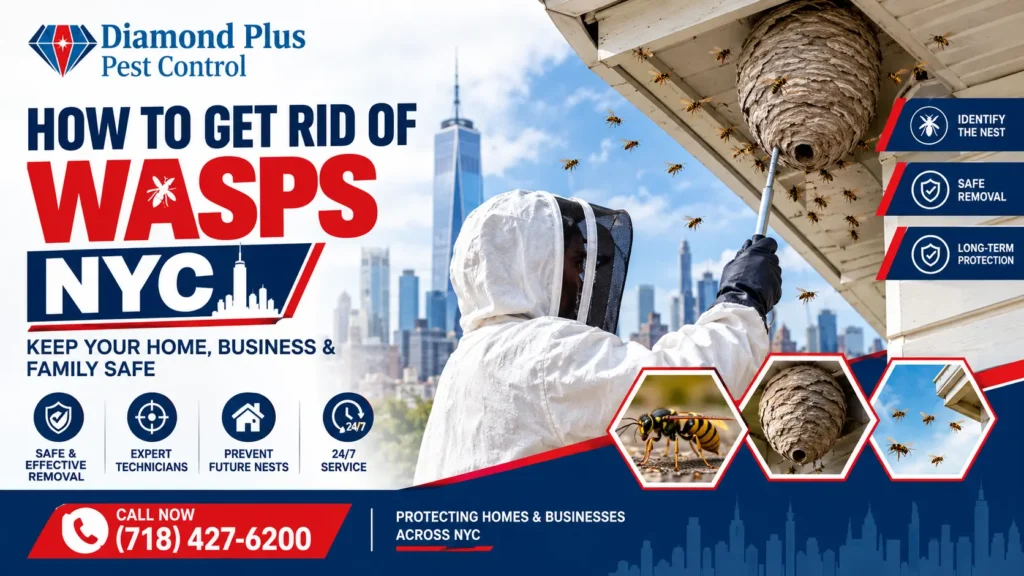
Wasps can turn a backyard, balcony, storefront, or building entrance into a stressful place quickly. In New York City, nests may appear under roof edges, inside wall gaps, in shrubs, or underground.
If you are trying to learn how to get rid of wasps in NYC, first determine whether there is an active nest, identify the likely insect, and decide whether the location can be managed safely. A few foraging wasps are different from a colony beside a doorway or inside a wall.
This guide gives practical steps for NYC homeowners, landlords, property managers, and business owners, while showing when Diamond Plus Pest Control may be the safer choice.
1. How to Get Rid of Wasps
Watch the wasps from a safe distance. If they repeatedly fly to the same crack, roofline, shrub, ground hole, or wall gap, a nest may be nearby.
Reduce attractants by sealing outdoor garbage, cleaning sugary spills, removing exposed food, and bringing pet food inside. These steps can reduce scavenging wasps around patios, yards, loading areas, and outdoor dining spaces.
Do not swat at wasps near a suspected nest. Fast movement can increase the chance of a defensive response. If the activity is close to an entrance, play area, balcony, sidewalk, customer seating area, or another high-traffic location, professional wasp removal NYC service may be the safer option.
For wider pest problems around the property, Pest Control nyc services can also help identify other conditions that may be attracting insects or allowing them to enter the building.
2. How to Identify a Wasp Nest
Wasp nests do not all look the same. Paper wasps often build exposed open-comb nests, yellowjackets may nest underground or in cavities, and bald-faced hornets commonly build enclosed paper nests.
Look for steady insect traffic instead of getting close. Repeated movement through one opening or buzzing inside a wall, ceiling, soffit, or attic can suggest a hidden colony.
Correct identification matters because bees, wasps, and hornets should not automatically be treated the same way. If you are unsure what you are seeing, How to Identify Bee, Wasp, and Hornet Nests Around Your NYC Property can help you compare common nest shapes, locations, and insect behavior before taking action.
3. Where Wasps Commonly Build Nests
NYC properties offer many protected nesting sites, from gaps around masonry, rooflines, vents, and utility penetrations to shrubs, sheds, fences, and ground cavities.
Common nesting locations include:
- Under eaves, soffits, and roof overhangs
- Inside wall voids, attics, and ceiling spaces
- Around balconies, decks, fences, and sheds
- Inside shrubs, hedges, and trees
- In ground holes or protected soil cavities
- Near exterior vents, utility openings, and building gaps
Finding the entry point is important, but do not immediately seal an opening if active wasps are still using it. Trapping an active colony inside a wall may cause insects to search for another route, including a route into the living or working space.
4. How to Get Rid of Wasps Around Your House
If you cannot find a nest, first remove food and shelter opportunities. Keep garbage closed, rinse sticky drink containers, clean eating areas, and pick up fallen fruit. These measures are especially useful when wasps gather around food and trash.
Check screens, exterior gaps, damaged trim, roof edges, vents, and other openings. Once you are certain there is no active nest inside, repair or seal vulnerable gaps that could become future nesting sites. Keeping shrubs and branches maintained can also make it easier to notice new nests early.
Wasps and bees are often confused. If the insects appear fuzzy, are carrying pollen, or seem to be entering a cavity without aggressive behavior, learn before deciding how the area should be managed. Bee colonies may require a different approach from aggressive wasp colonies.
5. How to Get Rid of a Wasp Nest
Homeowners often search how to get rid of wasp nests after finding one near the house. The safest response depends on its size, species, and location. A small exposed nest is very different from a colony beside a front door or inside a wall.
Avoid knocking down, burning, flooding, or sealing an active nest. These actions can trigger defensive behavior without eliminating the full colony. Store-bought pesticide products also need to be used exactly according to their label, and they may not solve hidden nests where the colony is protected inside a structure.
For active colonies in difficult locations, wasp nest removal NYC should focus on controlling the colony first and removing or managing the nesting area safely afterward. If the nest is inside a wall, under a roof edge, high above the ground, or near constant foot traffic, it is usually better to keep people away and arrange a professional inspection.
If the insects might actually be bees, the Bee Removal Cost in NYC guide can help property owners understand why species, access, colony size, and location can affect the service required.
6. When DIY Wasp Removal Is Not Safe
DIY removal is not a good choice when a nest is large, hidden, elevated, underground, close to people, or requires a ladder, attic access, or another risky position.
Do not attempt removal if anyone nearby has a known serious allergy to insect stings. Children, pets, tenants, customers, employees, and neighbors should also be kept away from an active nest until the risk has been addressed.
Hidden nests deserve extra caution. If wasps are entering a wall opening, do not plug the hole while the colony is still active. A trained wasp exterminator NYC can inspect the flight path, identify the likely nesting area, and choose an approach based on the structure and level of activity.
If someone is stung and develops trouble breathing, swelling of the face or throat, dizziness, or another severe reaction, seek emergency medical help immediately.
7. Why Professional Wasp Removal May Be Necessary
The biggest advantage of professional wasp removal is treating the problem as a colony issue rather than focusing on a few visible insects. Killing individual wasps does not remove a nest hidden in a wall, roof void, shrub, or underground cavity.
A technician can inspect where the insects are entering, determine whether the nest is exposed or concealed, and look at conditions that may allow another colony to establish later. This is especially valuable in NYC apartments, multi-unit buildings, restaurants, retail properties, warehouses, offices, and homes where shared structures make access more complicated.
Diamond Plus Pest Control can also help distinguish wasps from bees before treatment begins. Property owners dealing with mixed stinging-insect activity can review Bee Control in NYC for related information about bee problems and service options.
Professional service is most useful when safety, access, accurate identification, and full colony control matter more than a temporary reduction in visible activity.
8. How to Prevent Wasps From Coming Back
After current activity is resolved, inspect the exterior for cracks, damaged screens, loose trim, soffit openings, and other sheltered nesting areas.
Keep trash areas clean and use containers with secure lids. Restaurants and other businesses should pay extra attention to outdoor food service areas, dumpsters, recycling zones, loading areas, and employee break spaces. Residential properties should clean grills, tables, drink spills, and pet-feeding areas regularly.
Trim vegetation when it creates hidden, undisturbed nesting spaces near doors, windows, walkways, or play areas. Do not leave abandoned materials, open containers, or other protected cavities sitting around the yard for long periods.
Seasonal inspections can be useful for properties that have had repeated problems. Early nests are easier to spot before colony activity becomes heavy. If you are also dealing with bees or mixed activity around the same property, How to Remove Bees, Wasps can serve as a related guide for deciding which type of pest response is appropriate.
9. Wasp Removal in NYC
NYC includes row homes, apartments, restaurants, storefronts, warehouses, offices, and multi-unit properties, each with different nesting opportunities. A method suited to one exposed nest may not work for a colony inside brickwork, a roof void, or a busy entrance.
NYC guidance recommends avoiding active nests and using qualified pest-control help when nest removal creates a sting risk. On private residential and commercial property, owners are generally responsible for dealing with nuisance wasps that affect their property.
Diamond Plus Pest Control helps customers identify and control stinging insects around homes and businesses. The goal is not simply to reduce the wasps you can see. It is to locate the source, address the active colony where appropriate, and reduce conditions that may encourage another nest.
If wasps are repeatedly entering the same area, the nest is close to people, or you cannot safely locate the source, call Diamond Plus Pest Control to schedule an inspection and discuss the safest next step for your NYC property.
10. Frequently Asked Questions
1. What should I do if I see several wasps but cannot find the nest?
Watch their movement from a safe distance and look for repeated flights toward one location. Check roof edges, shrubs, wall gaps, vents, decks, and ground openings without approaching closely. If activity continues in the same area, a professional inspection can help locate a hidden nest.
2. Can I seal a hole if wasps are going into my wall?
Not while the colony is still active. Sealing the opening too early can trap wasps inside the structure and may push them toward another exit. The colony should be addressed first, and the entry point can be sealed after activity has stopped.
3. Why do wasps keep coming around my patio or outdoor dining area?
Food, sugary drinks, open garbage, recycling residue, pet food, and water can attract foraging wasps. Clean spills quickly, keep food covered, empty trash regularly, and use tight-fitting lids. If many wasps keep returning to the same route, there may also be a nest nearby.
4. Is every wasp nest dangerous?
Risk depends on the species, colony size, nest location, and how close people are to it. A nest far from normal activity may present less immediate risk than one beside a doorway, walkway, balcony, playground, or customer seating area. Avoid disturbing any active nest you cannot safely evaluate.
5. What is the safest way to deal with wasps near a business entrance?
Block access to the immediate area if possible and keep employees and customers away from the nest. Do not have staff knock it down or spray it during business traffic. A licensed pest professional can inspect the nest and plan treatment around safety and access needs.
6. When should I call Diamond Plus Pest Control for a wasp problem?
Call when the nest is hidden, large, elevated, underground, close to people, or difficult to reach safely. You should also get help when wasps are entering a wall, when the insect type is uncertain, or when repeated activity continues after basic sanitation and prevention steps. An inspection can help determine the source and the most appropriate solution.