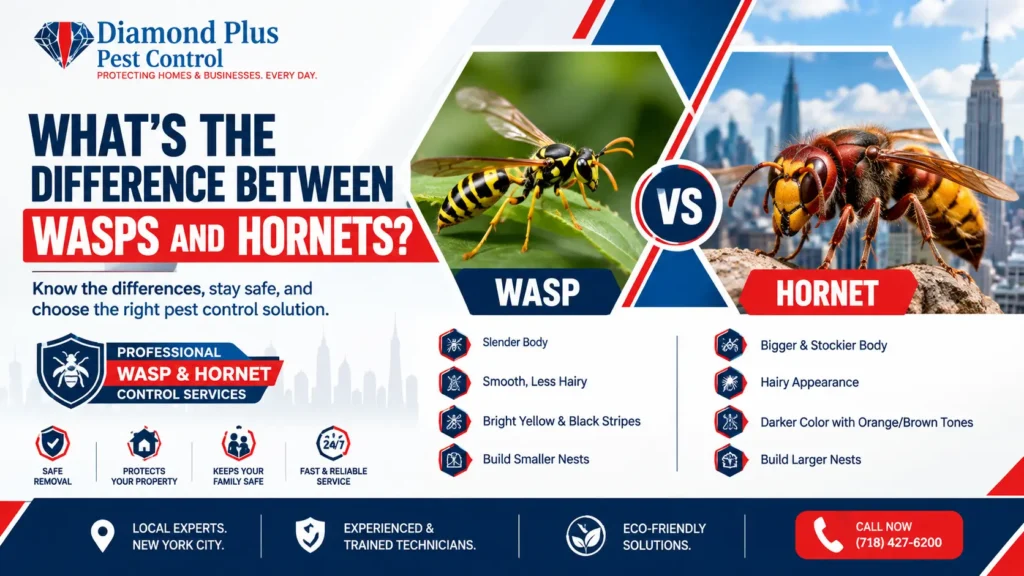
If you see a large stinging insect around your home or business, it can be hard to know what it is. Wasps and hornets often look similar. Their nests can also appear in many of the same places.So, what’s the difference between wasps and hornets?
Hornets are a type of wasp, but not every wasp is a hornet. They can differ in size, body shape, color, nesting habits, and behavior. Knowing the difference can help you decide what to do next.
This guide explains how to identify wasps and hornets around NYC properties. It also covers nests, sting risks, prevention, and safe removal options. Diamond Plus Pest Control helps homeowners and business owners handle stinging insect problems across New York City.
Are Wasps and Hornets the Same?
Wasps belong to a large group of stinging insects. Hornets are one group within that larger wasp family.
This means every true hornet is a wasp. However, many common wasps are not hornets. Paper wasps and yellowjackets are good examples. Bee Removal NYC can help address bee-related concerns.
The difference between hornet and wasp becomes easier to understand when you look at more than size. A large insect is not always a hornet. Some wasps are naturally large and may look more threatening than they actually are.
Another common source of confusion is the bald-faced hornet. Despite its name, it belongs to the yellowjacket group rather than the true hornet group.
If you are also seeing ants, roaches, rodents, or other insects around the property, professional Pest Control nyc service can help identify and address the wider pest problem.
Main Differences Between Wasps and Hornets
The hornets and wasps difference becomes clearer when you compare a few basic features.
- Size: Hornets are usually larger and heavier than many common wasps.
- Body shape: Many wasps have a thin waist and slim body.
- Color: Wasps may be yellow, black, brown, red, or mixed.
- Nest type: Different species build different paper nests.
- Behavior: Social wasps and hornets may defend their nests when disturbed.
These signs are useful, but you should never move close to an active nest just to identify the insect.
How to Identify Wasps and Hornets From a Safe Distance
Start by watching the insects from a safe area. Look at where they are flying and whether they keep returning to the same spot.
Paper wasps often have slim bodies and long legs. Their legs may hang down during flight. Their nests are usually open and show visible cells.
Yellowjackets often have shorter, stronger-looking bodies. They may be yellow and black or black and white. Some species nest underground, while others use walls or other protected spaces.
European hornets are usually larger. They often have reddish-brown and yellow markings. They may nest inside hollow trees, wall spaces, or other hidden areas.
If you are unsure what you are seeing, read How to Remove Bees, Wasps before trying to treat the area. Bees, wasps, and hornets may need different types of control.
Common Wasp and Hornet Species in New York
New York has several kinds of wasps that homeowners may see during warmer months.
People searching for hornet and wasp species may come across paper wasps, yellowjackets, bald-faced hornets, European hornets, and several solitary wasps.
Paper wasps often build smaller nests under eaves, decks, or other protected surfaces. Yellowjackets may nest in soil, walls, roofs, or other hidden areas. Bald-faced hornets often create large enclosed paper nests in trees or shrubs.
People researching types of wasps in ny may also find information about cicada killers. These insects are large, but they are solitary. They do not normally defend large colonies in the same way as yellowjackets.
If you searched wasp nyc because insects keep appearing around your property, watch their flight path. Wasps repeatedly entering the same hole, roof edge, wall gap, shrub, or ground opening may be returning to an active nest.
What Does a Wasp Nest Look Like?
Wasp nests can look very different depending on the species.
Paper wasps build open nests. The individual cells are visible, and the nest may look like a small umbrella. These nests are often found under roof edges, railings, or protected outdoor structures.
Yellowjacket nests are usually covered. Some are hidden underground. Others may be inside walls, ceilings, or building cavities.
Bald-faced hornets often build large gray or brown paper nests. These nests are usually enclosed and may hang from trees, shrubs, or structures.
European hornets often prefer hidden nesting areas. They may use hollow trees or spaces inside buildings.
If you find a nest and are thinking about removing it yourself, How to Remove Wasp Nest Safely explains why the nest location should be checked before any treatment begins.
Difference Between Wasp and Hornet Stings
The difference between wasp and hornet sting is not always easy to measure.
Both insects can deliver painful stings. Both may also sting more than once.
A person’s reaction can depend on the species, number of stings, sting location, and sensitivity to venom. Some people may only have mild redness or swelling. Others may have a serious allergic reaction.
Hornets are often larger, so their stings may feel very painful. However, yellowjackets can also create a serious risk when several insects defend the nest at the same time.
If someone has trouble breathing, throat swelling, dizziness, or a severe reaction after a sting, seek emergency medical help.
People with known sting allergies should never attempt DIY nest removal.
Are Hornets More Dangerous Than Wasps?
A common question is are wasps or hornets worse?
There is no simple answer.
A hornet is not automatically more dangerous just because it is larger. The real risk depends on the insect species, size of the colony, nest location, and how close people are to the nest.
A single wasp moving through a backyard may create little risk. A large nest beside a front door is very different.
Nests near balconies, sidewalks, playgrounds, outdoor dining areas, office entrances, or building doors deserve more attention because people may accidentally disturb them.
It is better to judge the situation by nest location and activity rather than insect size alone.
Difference Between Wasp and Hornet Nests
Understanding the difference wasps and hornets also means looking at how they build nests.
Paper wasps normally create exposed nests with visible cells. Yellowjackets may build enclosed nests underground or inside structures.
Bald-faced hornets often make large enclosed paper nests above ground. European hornets are more likely to use hidden spaces and natural cavities.
A hidden nest can be harder to handle because you may only see insects entering and leaving a small opening.
Never open a wall, ceiling, or roof area just to find the nest. Disturbing a hidden colony can cause defensive activity inside or around the building.
Where Wasps and Hornets Nest Around NYC Properties
New York City properties provide many protected spaces for nesting.
In residential areas, wasps may build nests near rooflines, decks, balconies, sheds, gardens, garages, and wall openings.
Apartment buildings may have nests around exterior walls, roof edges, vents, window areas, or shared outdoor spaces.
Commercial properties can have problems near storefront signs, dumpsters, loading areas, rooftops, outdoor seating, and landscaping.
Wasps may also enter small cracks around utilities or building materials.
If insects keep entering the same wall opening, do not seal it immediately. There may be an active colony inside.
When you are not sure whether the insects are bees or wasps, What Is Bee Control in NYC can help explain why correct identification should come before treatment.
What Should You Do When You Find a Wasp or Hornet Nest?
The first step is simple. Keep your distance.
Do not hit, shake, burn, flood, or knock down an active nest.
Keep children and pets away. Business owners should also keep customers and workers away from the area.
Watch from a safe distance if you need to confirm whether the nest is active. Regular insects entering and leaving usually mean the colony is still present.
The guide What to Do When You Find a Wasp explains the next steps homeowners can take after discovering activity around a property.
Professional inspection is a safer choice when a nest is large, hidden, high above ground, or close to busy areas.
How to Get Rid of a Wasp Nest
People searching for ways to get rid of wasp nests often want an immediate answer.
However, there is no single removal method that works for every nest.
A small open nest under an unused structure is different from a yellowjacket colony inside a wall. A nest beside a doorway also creates more risk than one far away from people.
Do not use a ladder beside an active nest. You should also avoid sealing a wall opening before the colony has been controlled.
A pest control professional can inspect the area first. This helps identify the insect, nest location, and level of activity.
If you are dealing with active wasps around your property, How to Get Rid of Wasps NYC provides more detailed local removal and prevention guidance.
Why Professional Wasp and Hornet Removal May Be Necessary
Visible wasps are often only part of the problem.
Killing a few insects flying around a property does not remove a hidden colony. The nest may still be active inside a wall, roof, attic, or underground space.
Professional service can help locate the main nesting area.
A technician can also determine whether the insects are paper wasps, yellowjackets, hornets, bees, or another species.
This is especially useful for commercial properties where customer and employee safety matters.
Diamond Plus Pest Control works with homeowners, landlords, apartment properties, restaurants, offices, retail businesses, warehouses, and other NYC locations.
The aim is to deal with the source of the activity rather than only the insects you can see.
How to Prevent Wasps and Hornets From Returning
Prevention starts after the active nest has been removed or controlled.
Check the outside of your building for small gaps around roof edges, soffits, vents, windows, utility lines, and exterior walls.
Repair damaged screens and trim.
Seal suitable gaps only after you know there is no active colony inside.
Keep garbage containers closed and clean food spills quickly. Sugary drinks, outdoor meals, and food waste can attract foraging wasps.
Restaurants and other businesses should keep outdoor dining areas, dumpsters, recycling areas, and loading zones clean.
Trim shrubs around entrances and walkways. This also makes new nests easier to see.
A simple exterior inspection during warmer months can help identify activity before a colony grows larger.
Wasp and Hornet Control in NYC
Wasps and hornets can affect many types of NYC properties.
Some nests are easy to find. Others remain hidden behind walls or inside building cavities.
The right solution depends on the insect species, nest size, location, and level of activity.
Diamond Plus Pest Control can inspect residential and commercial properties to locate the source of the problem.
The goal is not simply to spray insects flying around the property. Proper control should focus on the colony and conditions that may allow future nesting.
If wasps or hornets keep returning to the same location, the nest is difficult to reach, or people are at risk of being stung, contact Diamond Plus Pest Control for professional help.
Frequently Asked Questions
1. How can I tell if an insect is a wasp or hornet?
Look at its size, shape, color, and nesting behavior from a safe distance. Hornets are often larger and thicker, while many wasps have slimmer bodies. Do not approach an active nest just to identify the insect.
2. Are hornet stings always worse than wasp stings?
No. Both can cause painful stings. The level of risk depends on the species, number of stings, and the person’s reaction to venom.
3. Why are wasps going into a hole in my wall?
They may have a nest inside the wall or another hidden cavity. Do not seal the hole while wasps are actively entering and leaving. The colony should be checked first.
4. Can wasps and hornets sting more than once?
Yes. Many wasps and hornets can sting repeatedly. This is one reason you should avoid disturbing an active nest.
5. Should I remove a hornet nest that is high in a tree?
Not every distant nest needs immediate removal. However, a nest near people, entrances, walkways, or work areas may require professional attention.
6. When should I call Diamond Plus Pest Control?
Call when the nest is hidden, large, underground, difficult to reach, or close to people. Professional help is also useful when you cannot safely identify the insect or locate the nest.