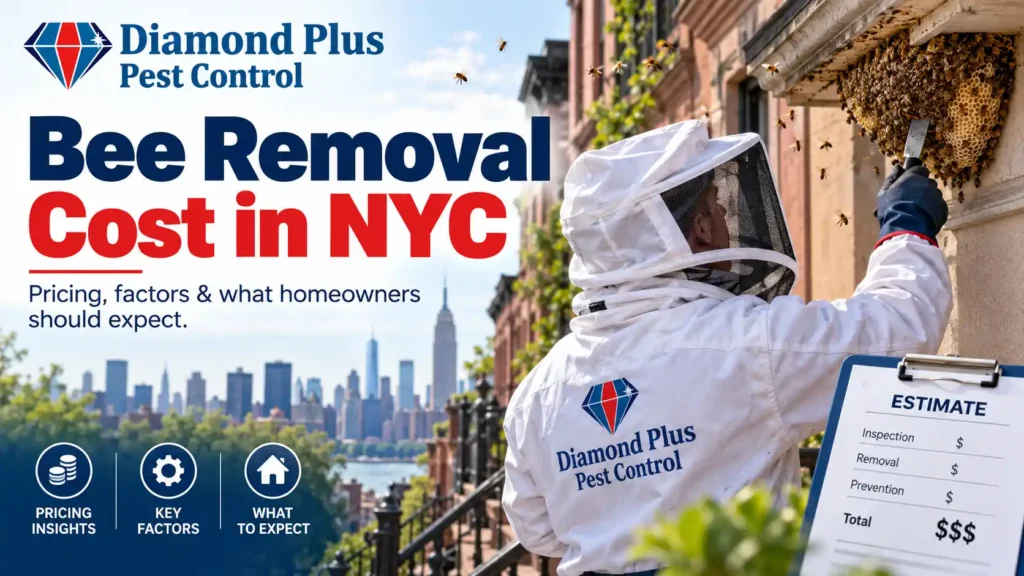
The typical Bee Removal Cost NYC depends on the bee species, colony size, hive location, access, and the work needed after removal. Diamond Plus Pest Control currently publishes a $200–$600 range for bee relocation. National 2026 market data puts many standard bee-removal jobs around $150–$500, while difficult hives inside walls, roofs, attics, or chimneys can reach $2,000 when access and repair work are involved.
Here is a quick price guide before we explain what changes the final quote.
The market figures above are budgeting estimates, not fixed Diamond Plus rates. Angi’s July 2026 data provides the species and structural-location estimates, while Diamond Plus’s current published cost guide provides its own relocation, emergency, and follow-up ranges. Your actual NYC price should be based on inspection.
If your property has other pest activity as well, the Pest control nyc page can help you review broader services without mixing unrelated pest costs into your bee-removal estimate.
| Bee Removal Service | 2026 Price Guide | Why the Price Can Change |
| Diamond Plus bee relocation | $200–$600 | Hive size, access, species, removal scope |
| Typical professional removal | $150–$500 market estimate | Colony size and hive location |
| Accessible bee swarm | $125–$200 market estimate | Height and ease of collection |
| Honeybee removal | $75–$2,000 market estimate | Live removal, comb, structural access |
| Carpenter bee treatment | $75–$500 market estimate | Number of holes and damaged wood |
| Bumblebee removal | $75–$500 market estimate | Colony location and access |
| Wall or ceiling hive | $200–$750 market estimate | Wall opening, comb removal, repairs |
| Roof or attic hive | $200–$1,100 market estimate | Height, access, roofing or soffit work |
| Chimney hive | $200–$1,500 market estimate | Height and difficult structural access |
| Diamond Plus emergency service | $300–$700 published range | Urgency and after-hours scheduling |
| Diamond Plus follow-up | $100–$250 published range | Inspection and preventive treatment |
Why Bee Removal Prices Vary So Much in New York City
There is no useful one-price-fits-all answer for bee removal.
A visible cluster of honeybees on a low branch is very different from an established colony behind the brick wall of a brownstone. The first may require collection and relocation. The second may require access to the wall, colony removal, comb cleanup, sealing, and later building repair.
That is why someone researching Bee Removal Cost NYC may see very different prices from different companies.
The technician needs to know what insect is present. The location also matters. Height, wall construction, roof access, ladders, scaffolding, fire escapes, shared building spaces, and business-hour restrictions can all affect labor.
NYC’s dense buildings make this especially important. A colony in a detached suburban shed is not the same job as bees entering masonry several floors above a Manhattan sidewalk.
The broad bee control cost NYC also depends on what the customer means by “control.” Treating active insects, removing the colony, removing comb, sealing the entry point, and repairing a wall are separate parts of the job.
A good quote should make those differences clear.
Bee Removal Cost by Species
Correct identification should come before pricing. Honeybees, carpenter bees, bumblebees, wasps, and hornets do not create the same type of problem.
If you cannot tell what insect you have, How to Identify a Bee, Wasp, or Hornet Nest is a useful internal guide before comparing treatment options.
Honeybee Removal Costs
The honey bee removal cost NYC property owners face can vary more than almost any other bee job.
Current nationwide 2026 estimates range from roughly $75 to $2,000. The lower end may apply to a simple, accessible situation. Structural colonies can move toward the high end because removal may involve thousands of bees, wax comb, stored honey, and building access.
Diamond Plus currently publishes $200–$600 for live bee relocation. That is a company-published range, but it still should not be treated as a guaranteed price for every wall, roof, or chimney colony.
Honeybee work may focus on relocation when the situation allows. Removing only the visible bees may not solve an established structural colony if the comb remains inside.
For homeowners comparing Bee Removal Cost NYC, the species and whether the colony can be safely relocated are important factors to discuss during an inspection.
Carpenter Bee Treatment Costs
Carpenter bees create a different cost problem.
They do not build large honeybee-style hives. They make nesting galleries in wood. Decks, fascia, railings, trim, and other exposed wood can be affected.
The carpenter bee treatment cost NYC may fall around $75–$500 based on current national market estimates. Price depends on how many nesting holes are active and how much wood must be inspected.
The carpenter bee exterminator cost can also rise when activity is spread across a large deck, roof edge, fence, or several sections of a building.
Treatment and wood repair should be priced separately when repair is needed. Pest-control work stops the active issue. A carpenter or other contractor may still be required for damaged wood.
Bumblebee Removal Costs
The bumblebee removal cost generally falls in the same broad $75–$500 market range, but the actual situation matters.
Bumblebees often use protected cavities or ground-level locations. Some colonies may be away from people and create little risk. Others can be close to doors, yards, walkways, or customer areas.
NYC Health says a bee hive or nest does not always need removal unless it poses a direct threat to people. When removal is necessary, the city recommends professional help.
Need Professional Bee Removal in NYC?
Found a bee hive or active bee colony on your property? Our experienced pest control professionals can inspect the problem and provide safe, effective bee removal solutions for your home or business.
Why Bee Removal Prices Vary So Much in New York City
How Much Does Bee Swarm Removal Cost in NYC?
A swarm is not the same thing as an established hive.
Honeybees can temporarily gather in a large cluster while searching for a permanent location. At this point, they may not have built a significant comb.
The market estimate for bee swarm removal NYC is often around $125–$200 for accessible situations. Some beekeepers may help with certain honeybee swarms at little or no cost, but this is not guaranteed.
The New York City Beekeepers Association says it may be able to assist with some honeybee swarms around the NYC area. Availability depends on the location and positioning of the swarm.
An established colony is different. Once bees have moved into a wall, roof, or other cavity and started producing comb, the scope becomes much larger.
When comparing Bee Removal Cost NYC, customers should first determine whether they are dealing with a temporary swarm or an established colony.
Beehive Removal Cost vs. Basic Bee Treatment
The beehive removal cost NYC is often higher than a basic treatment because the hive itself may need attention.
A complete structural job can involve identifying the entry point, reaching the colony, managing active bees, removing wax and comb, cleaning the cavity, and preventing reuse of the opening.
The bee nest removal cost NYC is a common search term, although honeybees build hives and wax comb rather than the paper nests associated with many wasps.
This difference matters when comparing phone quotes.
One company may be quoting active-bee control. Another may be quoting full hive extraction. The prices cannot be compared fairly unless the scope is the same.
For a broader explanation of what professional control means, see What Is Bee Control in NYC.
Cost to Remove Bees From a Wall
Structural colonies are one of the most important NYC cost topics.
The cost to remove bees from wall areas is usually higher because technicians cannot always reach the colony from the exterior entry hole.
Current 2026 market estimates place wall or ceiling bee removal at about $200–$750. Very complex structural work can move the overall project toward $2,000 when extensive access or carpentry is required.
However, bees in wall removal cost should not be confused with the cost of replacing drywall, masonry, trim, or other building material.
Angi currently estimates drywall replacement at about $275–$750 when wall access is required. Structural repairs can therefore become a separate part of the total project.
That is why a proper estimate should tell you whether repair is included or handled by another contractor.
If bees are repeatedly entering one wall opening, do not assume sealing the hole first will solve the problem. The colony should be assessed before the access point is closed.
For customers researching Bee Removal Cost NYC, a colony inside a wall can require a different service scope from an exposed swarm or easily accessible hive.
Roof, Attic, and Chimney Bee Removal Prices
High or hidden locations create added labor and safety needs.
The bee removal from roof cost can vary based on roof pitch, height, hive access, roofing material, and whether soffits or exterior panels must be opened. Current roof and attic removal estimates are about $200–$1,100.
The attic bee removal cost can increase when technicians must work around insulation, restricted access, hot spaces, or hidden comb.
Chimneys can be even harder to reach. Current market data places chimney bee removal cost around $200–$1,500, depending on access and hive location.
A hidden beehive removal cost may therefore be much higher than an exposed swarm because the technician first needs to locate the colony and determine how it can be reached safely.
NYC brownstones, townhouses, apartment buildings, and commercial buildings can add another layer of difficulty because exterior access may require coordination with building management or safe access from upper floors.

Swarm Removal vs. Established Hive Removal
This distinction is one of the biggest content gaps identified in your competitor analysis.
A swarm is normally a temporary cluster. There may be no established honeycomb in the structure yet.
An established colony has moved into a suitable location and begun using it as a home. It may contain comb, honey, brood, and a regular entry point.
That difference affects the price.
An accessible swarm may be collected without opening the structure. An established hive inside a wall or roof may need much more labor.
This is also why waiting can change the job. If a swarm moves into a building cavity and establishes a colony, removal can become more complex.
Understanding this difference can make a Bee Removal Cost NYC estimate easier to understand because the technician can price the actual service rather than a generic bee-removal job.
Treatment, Colony Removal, Comb Removal, and Repair Are Different Costs
Customers should know exactly what they are buying.
A professional bee removal NYC quote may contain several separate services.
Treatment deals with the active insects.
Colony removal addresses the bees occupying the nesting area.
Comb and honey removal deal with hive material left inside the structure.
Entry-point work can help stop new activity from using the same opening.
Building repair restores drywall, soffits, roofing, siding, masonry, or trim after access.
Do not assume every company includes all of these steps in one price.
What a Complete Bee Removal Quote Should Include
- Inspection and insect identification; exact treatment area; whether the quote covers active-bee control or full colony removal; whether honeycomb and wax removal are included; access or opening work; entry-point sealing; number of follow-up visits; structural repair responsibility; emergency or after-hours charges; warranty terms; and the final quoted price.
This is especially important when comparing affordable bee removal NYC options. The lowest number is not automatically the lowest total cost if important work is excluded.
Bee Inspection and Follow-Up Costs
Some companies charge for inspections. Others apply the inspection fee toward service.
Diamond Plus Pest Control currently advertises a complimentary inspection and estimate on its main website.
This matters because a useful bee quote normally requires more than a phone description.
A technician may need to confirm the insect, locate the entry point, check height and access, and determine whether the issue is a swarm or an established structural colony.
Diamond Plus also currently publishes $100–$250 for preventive follow-up service.
Most bee removals are not recurring monthly pest-control programs. A follow-up is more likely to check activity, confirm the colony is gone, or address prevention needs.
If you want to understand what happens during professional service, Bee Removal Process in Queens NY explains the inspection and treatment process in more detail.
One-Time Bee Removal vs. Emergency Service
A standard scheduled visit usually costs less than urgent or after-hours work.
Diamond Plus’s published guide currently lists emergency or after-hours service at $300–$700.
Searches for emergency bee removal NYC often involve bees entering an occupied room, activity near a busy doorway, a known sting risk, or a commercial area that cannot easily be closed.
If you need same-day bee removal NYC, Diamond Plus currently states that same-day service is available. Actual scheduling still depends on technician availability, location, and the job.
Do not delay emergency medical care to wait for pest control. Severe allergic reactions to bee stings require medical attention.
NYC Bee Removal Costs by Property Type
Property type changes the work even when the bee species is the same.
A single-family home may have accessible siding, roof, deck, attic, or yard areas. This can simplify inspection compared with a taller urban structure.
A brownstone or townhouse may have upper-floor masonry gaps, cornices, rear-yard access, or difficult rooflines. Height and exterior access can increase labor.
An apartment or condo may require building approval. The visible entry point may also be outside the individual unit.
A co-op may involve the superintendent, board, management company, or common-area access.
Restaurants can create urgent scheduling concerns because bees near entrances or outdoor dining areas affect customers and staff.
Retail stores and offices may need service outside busy hours.
Warehouses can involve high ceilings, loading areas, exterior wall voids, and specialized access equipment.
These NYC property differences were a major gap highlighted in your competitor brief and are worth keeping in the final published guide.
For customers ready to move from pricing research to service details, Bee Removal NYC should be the primary internal service link from this section.
Residential vs. Commercial Bee Removal in NYC
The scope of residential bee removal NYC usually depends on where the colony is relative to the people living in the property.
A hive near a bedroom window, deck, front door, children’s play area, or inside a wall deserves a different response from bees passing through a garden.
Commercial properties have other concerns.
The cost of commercial bee removal NYC may reflect the size of the property, number of affected areas, business hours, customer exposure, required access equipment, and urgency.
A restaurant with bees around outdoor seating may need rapid scheduling. A warehouse colony high above a loading area may require lift equipment. A retail property may need work planned around pedestrian traffic.
Commercial estimates should therefore be based on the actual site rather than a simple residential starting price.
Who Pays for Bee Removal in an NYC Rental?
Tenants should first report the problem to their landlord, superintendent, or building manager.
NYC311 states that the City does not remove bees or wasps from private property. It also says residential and commercial property owners are responsible for removing nuisance bees and wasps from their property. Tenants are advised to contact their landlord or building management first.
That does not mean every cost dispute is identical.
The nesting location, lease, common-area responsibility, building ownership, and circumstances can matter. A renter should document the issue and contact management rather than assuming who must pay.
Avoid making legal guarantees in the blog. For a specific landlord-tenant dispute, readers should check their lease and current NYC guidance.
Does NYC Offer Free Bee Removal?
Not as a general City service for private property.
NYC311 clearly states that the Health Department does not remove bees, wasps, or their hives from private property. Property owners must arrange removal when nuisance insects on their property need to be addressed.
Honeybee swarms are a special case.
The New York City Beekeepers Association says it may be able to assist with certain swarms in the NYC area. That does not mean every hive, wall colony, roof colony, or structural job will qualify for free removal.
Some beekeepers may accept accessible honeybee swarms because the colony can be relocated. Established hives inside buildings require far more work and often come with a professional service cost.
Does Homeowners Insurance Cover Bee Removal?
Usually, homeowners should not assume standard insurance will pay for a bee infestation.
Many homeowners policies exclude damage from insects or infestation. State Farm, for example, lists insects among common excluded causes of loss. Its policy materials also show that removal and prevention costs related to insect infestation may be excluded.
Coverage can vary by policy and by the cause of damage.
Do not tell readers that insurance will or will not cover a specific claim without seeing the policy. The safest advice is to contact the insurance carrier before major structural work when coverage is a concern.
DIY Bee Removal vs. Hiring a Professional
DIY may look cheaper because store-bought materials cost less than professional labor.
The risk is that a homeowner may not know the species, colony size, or actual hive location.
A visible entry hole can be several feet away from the main comb.
There is also a sting risk when an active colony is disturbed.
NYC Health says hives that directly threaten people should be removed by a certified exterminator. It also notes that bee species need to be managed differently.
If the insects are actually wasps, treatment can be different again. What’s the Difference Between Wasps and Hornets? can help users compare the insects before assuming they have a bee colony.
For users dealing with a wasp rather than a bee issue, link them to How to Get Rid of Wasps NYC rather than forcing wasp intent onto this cost page.
Likewise, How to Remove Wasp Nest Safely is more relevant to users who have confirmed a wasp nest. Keeping these topics separated helps your pages support each other without competing for the same keyword.
Why Waiting Can Make Bee Removal More Expensive
A small amount of activity today may not stay small.
An established honeybee colony can build more comb over time. The nesting area may become harder to access. Honey and wax can also increase the cleanup scope after removal.
Commercial exposure may increase too. Bees around a restaurant entrance, sidewalk, rooftop work area, or loading area can affect more people than a quiet colony away from activity.
The article Signs You Need Professional Bee Control in NYC can support users who are unsure whether their current bee activity has reached the point where professional inspection makes sense.
Taking action early does not guarantee the lowest possible price. It does reduce the chance that a simple inspection becomes a much larger structural job because the colony has been left undisturbed for a long period.
How Diamond Plus Pest Control Prepares a Bee Removal Quote
A useful quote begins with the actual property.
Diamond Plus Pest Control currently advertises a free pest inspection and estimate. Its site also promotes residential and commercial bee and wasp service, all-borough coverage, and same-day availability.
A technician may need to know the borough and ZIP code, property type, where the activity is located, approximate height, whether a nest is visible, how long activity has been present, and whether building approval is required.
Photos taken from a safe distance may help explain the situation before arrival.
Searchers looking for a bee exterminator NYC should ask whether the price includes only treatment or complete hive work.
The same applies when comparing a local bee removal company NYC search result. Look at the scope, licensing, access plan, follow-up, and whether structural repairs are separate.
For homeowners searching Bee Removal Cost NYC, getting an inspection helps connect the general market range with the actual conditions at the property.
Why Choose Diamond Plus Pest Control for Bee Removal in NYC?
Diamond Plus Pest Control serves homeowners, landlords, property managers, restaurants, offices, retail properties, and other commercial locations across New York City.
The company currently promotes licensed experts, free inspections and estimates, same-day service availability, residential and commercial pest control, and service across the five boroughs.
A local inspection is especially useful when bees are entering brickwork, roof edges, wall voids, soffits, chimneys, apartment structures, or areas with limited access.
The goal should not be to offer one cheap phone price for every customer.
The goal is to identify the species, locate the colony, understand the building, and explain what is included before work begins.
That gives the customer a more useful answer than a generic national average.
Frequently Asked Questions About Bee Removal Cost in NYC
1. How much does professional bee removal usually cost in NYC?
Many standard jobs fall within a broad $150–$500 market range. Diamond Plus currently publishes $200–$600 for bee relocation. Wall, roof, attic, chimney, or other difficult structural colonies can cost much more because access and repair work may be involved.
2. Is removing a bee swarm cheaper than removing a hive from a wall?
Usually, yes. An accessible swarm may cost around $125–$200 based on current market estimates. A wall colony can cost more because technicians may need to reach an established comb and the building may need repairs afterward.
3. How much does it cost to remove bees from an attic or roof?
Current market estimates place roof or attic removal around $200–$1,100. Height, hive size, soffit access, roofing materials, and structural work can move the final price up or down.
4. Does Diamond Plus Pest Control charge for a bee inspection?
Diamond Plus currently advertises a complimentary inspection and estimate on its website. The actual removal price is then based on the bee type, colony location, access, and required service.
5. Can I get bee removal for free in NYC?
NYC does not provide routine free removal of bees or hives from private property. Some beekeepers may assist with accessible honeybee swarms, but availability and eligibility vary. Established structural colonies normally require more work.
6. How can I get an accurate price for my property?
Provide your borough, ZIP code, property type, where the bees are entering, approximate height, how long activity has been present, and any safe-distance photos. A professional inspection can then separate removal, hive cleanup, sealing, follow-up, and structural repair costs.
Get an Accurate Bee Removal Quote in NYC
Bee removal prices in NYC depend on much more than the number of bees you can see.
Species, colony size, wall or roof access, height, hive material, building type, urgency, follow-up needs, and structural work can all change the total.
If you need a bee removal service for an apartment, brownstone, house, restaurant, office, retail store, or other NYC property, start with an inspection instead of relying only on a generic internet price.
For an accurate Bee Removal Cost NYC estimate, Diamond Plus Pest Control currently publishes $200–$600 for bee relocation and offers free inspections and estimates. Call (718) 427-6200 to request a quote based on the actual nesting location and service scope.